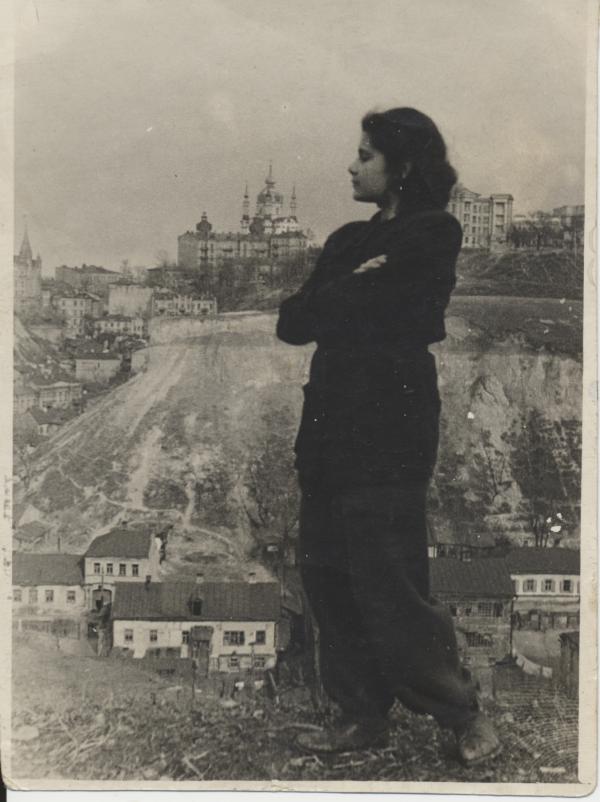
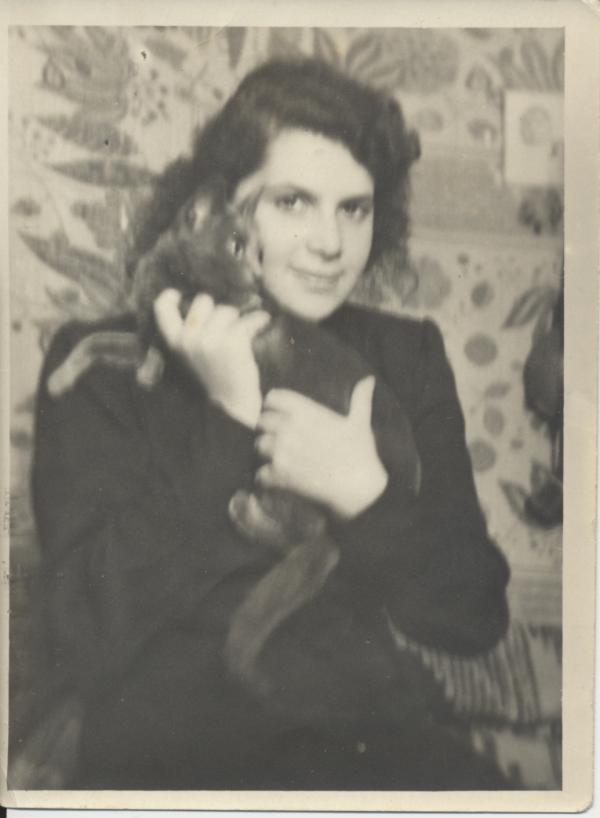
Born on 1 August in Kharkiv. Her father was Peretz Markish, a Soviet poet of Jewish descent from Volhynia who wrote in Yiddish; her mother was Zinaida Yoffe, a linguist and translator. Her parents divorced before Olga was born but remained on good terms. In the late 1920s and early 1930s, Zinaida married Ukrainian translator and writer Borys Tkachenko.
1930sIn the early 1930s, her mother was forced to take Olga and her older sister, Maya, to stay with their maternal grandparents in the village of Huliaipole (now a city in the Zaporizhzhia region).
After Kyiv regained its status as the capital, the family moved there and settled in a two-room apartment in an annex of a building at the corner of Khreshchatyk and Instytutska streets. In both Kharkiv and Kyiv, they maintained close ties with fellow writers, literary figures of the older generation, young authors, and linguists. Almost all of this circle of friends fell victim to the brutal wave of Stalinist repression in the 1930s. Today, they are remembered as figures of the Executed Renaissance.
1937–1938Olga's stepfather, Borys Tkachenko, was arrested on charges of belonging to a “fascist terrorist bourgeois-nationalist organisation” and executed two months later on the orders of a so-called troika. In 1954, his case was reviewed, and Tkachenko was posthumously rehabilitated due to the absence of a crime. Writer Volodymyr Vladko, literary scholar Oleksandr Biletskyi, and linguists Leonid Bulakhovskyi and Mykola Nakonechnyi testified in his defence. Upon learning of Borys Tkachenko's arrest, Peretz Markish and his wife Esther took Olga to Moscow, where she would live with them for the next ten years. On 1 January 1938, Zinaida Yoffe was arrested as a “family member of a traitor to the Motherland” and sentenced to five years in corrective labour camps. However, her punishment was eventually extended to ten years of exile. Olga's elder sister was sent to a special institution for children of “enemies of the people”. Despite the hardships that Olga endured at such a young age, these years played a particularly important role in shaping her worldview. “We grew up in an atmosphere of literary and poetic interests; every new literary publication became part of our world — the house was filled with books,” she would recall later¹. Peretz Markish's home was visited by figures from the theatre and cultural worlds, prose writers and poets — both emerging talents and established masters of literature — as well as translators and journalists. This environment undoubtedly influenced Olga's development.
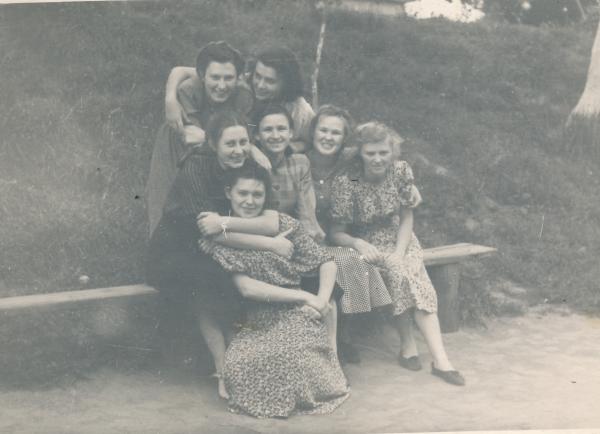
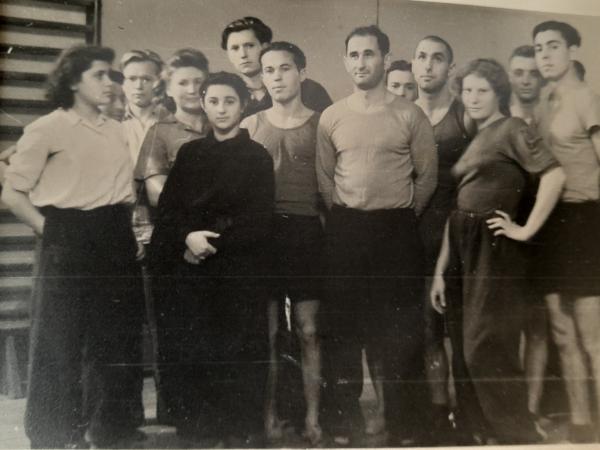
1940sWith the outbreak of the Second World War, the family was evacuated to Central Asia. Peretz Markish initially joined the people's militia and took part in digging defensive trenches. He was subsequently recruited as a war correspondent for the Northern Fleet, holding the rank of Captain 2nd Rank. In 1942, he joined the Jewish Anti-Fascist Committee. In the late 1940s, following the murder of Solomon Mikhoels and the beginning of a new wave of anti-Jewish policies by the Kremlin, the Markish family, sensing the approaching danger, sent Olga to Kharkiv, where she enrolled at the Kharkiv State Art College.
1949After a year of studying in Kharkiv, Olga enrolled at the Kyiv State Art Institute. Around this time, her mother was released from the camps and returned to Ukraine, although she was forced to live semi-legally: she settled not in Kyiv, where she was prohibited from residing until 1954, but at the Writers' Union summer residences in Irpin. Following the final destruction of the Jewish Anti-Fascist Committee, against the backdrop of the Soviet campaign against “rootless cosmopolitans” — a euphemism for the state-sponsored anti-Jewish campaign — Peretz Markish was arrested on 27 January 1949. Like most Jewish cultural and academic figures of the time, he was charged with a whole range of alleged crimes: bourgeois nationalism, espionage on behalf of the Soviet Union's enemies under the guise of his activities in the Jewish Anti-Fascist Committee, and involvement in the so-called Crimean Affair.
1952–1953On 12 August, following a closed trial, Peretz Markish was executed along with twelve other members of the Jewish Anti-Fascist Committee. This date would go down in history as the “Night of the Murdered Poets”. The tragedy radically changed the fate of the entire family. In an instant, Olga lost her right to live freely. She was arrested during a class in the art institute's studio and deported to Eastern Siberia, to the village of Dolhyi Most. There, she met Kyrylo Hvozdyk, an artist who had miraculously survived the persecution and extermination of Mykhailo Boichuk's students and associates and who was a central figure in the Ukrainian community of exiles. In the summer, following Stalin's death, Olga was visited by her mother and fiancé, Mykola Rapai, her fellow student. The couple married, after which Mykola and Zinaida Yoffe returned to Kyiv.
1954–1955Olga received permission to relocate under escort to Kyzylorda, where her stepmother and brothers were living in exile. For a time, she worked as a cleaner at a leprosarium. On 10 April 1954, she gave birth to her daughter Kateryna. Despite the complicated system of permits, Mykola Rapai managed to obtain permission to travel to see his family. In the autumn of 1954, the Military Collegium of the Supreme Court of the USSR overturned Olga's conviction. After returning from exile, she was prohibited from living in capital cities and regional administrative centres, so she initially stayed with her mother-in-law in the village of Novoukrainka in the Kuban region. She eventually obtained a passport and returned to Kyiv, where she resumed her studies at the art institute. The rector, Serhii Hryhoriev, who knew Olga and Mykola's story, helped the talented students: he had originally admitted them to the institute, later supported Mykola's decision to travel to join his fiancée in exile, and now reinstated both of them as students. Olga would later recall the atmosphere at the institute at the time: “We had teachers, studios, models — everything as it should be... The director at the time was Serhii Oleksiiovych Hryhoriev, a very serious painter — a Peredvizhnik, a naturalist, a genre painter. And this idea of genre painting was stifling all the departments. I was carried away from there. In general, my real education began after the institute.”²
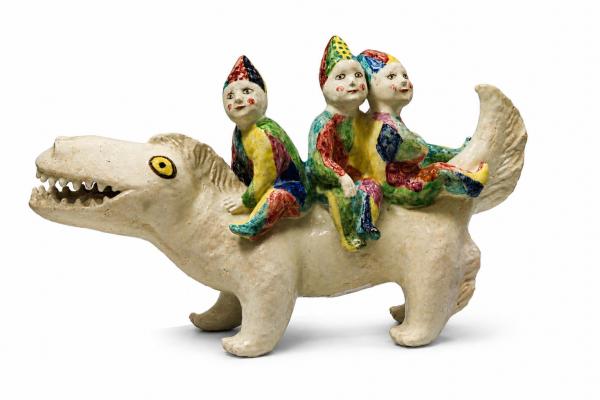
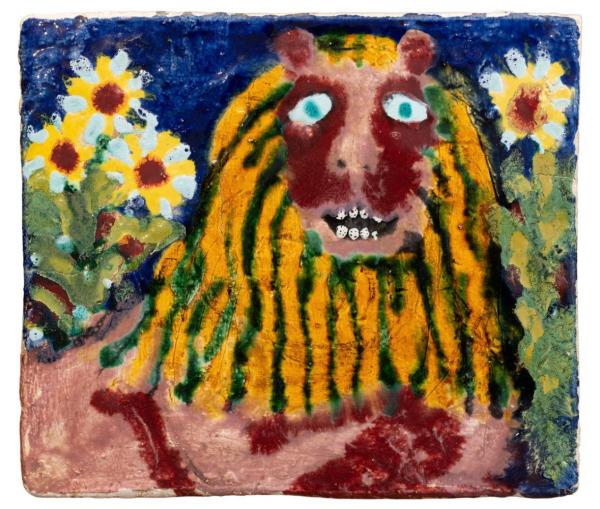
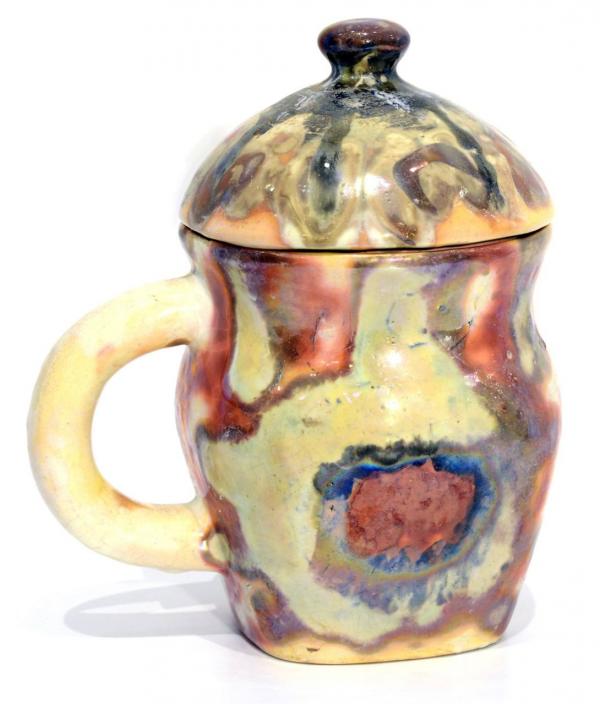
1956–1959Graduates from the Kyiv State Art Institute (1956). Her teachers included Maks Helman and Mykhailo Lysenko. Immediately after defending her diploma project, Olga was invited to work at the Kyiv Experimental Ceramic and Art Factory. This pivotal step not only connected her professional life with the factory for eleven years but also defined the principal direction of her subsequent artistic practice: ceramic sculpture. During her years at the factory, she created approximately seventy works, distinguished by exceptional craftsmanship, originality of artistic vision and a distinctive personal style. Having no home of their own, Olga and Mykola temporarily lived in the apartment of Alla Horska and Viktor Zaretskyi. Soon afterwards, the family moved into the house of Heorhii Yakutovych, who lived on Kudriavska Street with his wife and son. These years, filled with mutual support, shared interests and close friendships, became perhaps the happiest period of Olga's life.
1960Becomes a member of the Union of Artists of the USSR. In the early 1960s, the family received a room in a communal apartment from the Kyiv Experimental Ceramic and Art Factory.
1964Turns to the subject of the circus, which becomes one of the central themes in her work. According to R. Daskalova, it was in the porcelain small-scale sculpture series Circus that Olga “succeeded in achieving the most complete synthesis of the sculptural and colour qualities of porcelain sculpture” at that time.³ Equally well-known are the figurines from the Beach and Jazz series, which were produced by factories in Kyiv, Polonne and Korosten.
1965For the first time, she participates alongside other Ukrainian sculptors in the international symposium of ceramic sculptors, held periodically at the Artists' Union Creative House in Dzintari, Latvia.
1967Leaves the Kyiv Experimental Ceramic and Art Factory and begins a thirty-year collaboration with the Art Fund of the Ukrainian SSR. She creates a series of monumental and decorative ceramic works for the interiors and exteriors of cafés, restaurants, schools and other public buildings in various Ukrainian cities. Among other projects, she produces ceramic interior and exterior decorations for newly constructed buildings designed by architect M. Budylovskyi. Unfortunately, a considerable number of these works have not survived; only slides and photographs remain. Among her first monumental works are polychrome relief compositions for the House of Trade in Kyiv (not preserved).
1968Her first exhibition of ceramic and porcelain works takes place at the Artists' Union exhibition hall on Chervonoarmiiska Street (now Velyka Vasylkivska Street) in Kyiv. The works are exhibited alongside graphic pieces by Oleksandr Hubariev. In an enthusiastic review published in the newspaper Literaturna Ukraina, Yurii Shcherbak describes the event as “perhaps the finest among the many exhibitions of the past decade”.⁴
1970sCreates ceramic reliefs for the decoration of a café in Okhtyrka, Sumy Oblast (1970, not preserved). Together with Borys Dovhan, she works on the large ceramic panels Young Kyiv and Ancient Kyiv for the restaurant at the Slavutych Hotel, as well as creating decorative lamps and vases (1973; architects V. Ladnyi and H. Kulchytskyi; not preserved). She creates a modular ceramic object with reliefs for the Lisova Polyana sanatorium in Pushcha-Vodytsia (1973; M. Syrkin architectural studio, architect V. Prach; now the Lisova Polyana Mental Health and Veterans Rehabilitation Centre). She also produces sculptures, reliefs and paintings for the Krakow restaurant in Kyiv (1974, not preserved). Completes the decoration of the shopping centre at 5–27 Brest-Lytovskyi Avenue (now Beresteiskyi Avenue), a project that had been underway since 1968 (architect M. Budylovskyi). Polychrome ceramic reliefs adorned, among other spaces, the dairy kitchen, theatre ticket office, rental service and delicatessen shop (not preserved). In 1973, Olga and Mykola's marriage comes to an end, although they maintain a friendly relationship in the years that follow. In 1974, she receives two adjoining studios on Perspektyvna Street from the Artists' Union; one of the premises is relinquished by Mykola Rapai.
1977–1982Creates reliefs for the actors' lounge at the Lesya Ukrainka National Academic Drama Theatre in Kyiv (1977). She works on the interior decoration of the State Republican Library for Children in Kyiv (1979; architect M. Budylovskyi, now the National Library of Ukraine for Children), creating, among other works, a series of reliefs entitled The First Printers, the three-dimensional spatial composition Musical Tree, and the panel Fairy Tales of the Peoples of the World (some of these works have not survived). In 1980, she creates decorative polychrome ceramic sculptures, small-scale sculptures, reliefs and lamps for the café in the conference hall of the O. O. Bohomolets Institute of Physiology of the National Academy of Sciences of Ukraine in Kyiv. In 1981, she works on ceramic reliefs, panels, a frieze and vases for two restaurant halls, the lobby and other interiors of the Bratislava Hotel in Kyiv (architects V. Ladnyi and H. Kulchytskyi; the works have been removed from the hotel walls, although some elements of the decoration have survived). In 1982, she creates the spatial composition Plant, reliefs, vases and lamps for the lobby of the M. H. Kholodnyi Institute of Botany of the National Academy of Sciences of Ukraine in Kyiv.
1985–1987Works on the large-scale monumental ensemble of ceramic panels I Love You, Ukraine!, covering an area of more than 300 m² on the façade of the House of National Creative Ensembles of Ukraine in Kyiv. The work, which demonstrates a particularly strong influence of Ukrainian folk art, was included in the list of Kyiv's cultural heritage sites in 2026.
2009Due to a serious illness requiring appropriate medical treatment, she emigrates to Israel.
2012On 1 February, Olga Rapai-Markish dies in Petah Tikva, Israel.
¹ Olga Rapai's memoirs / recorded by I. Lisnichenko // Sobytiia i Liudi. 29 December 2008 – 5 January 2009. ² From a video interview with Roman and Anna Lenchovskyi. Kyiv, 1998. ³ Olga Rapai. Sculpture / article by R. Daskalova; Union of Artists of the Ukrainian SSR. Kyiv, 1968, p. 4. ⁴ Shcherbak, Y. “From the Roots of Folk Art” // Literaturna Ukraina. 1969.